Blogging Tools for Beginners: What You Actually Need
If you’ve been researching blogging tools, you’ve probably seen long lists.
“Top 25 tools.”
“Must-have software.”
“Every blogger needs this.”
And suddenly it feels like you need five subscriptions before you even write your first post.
You don’t.
Blogging does not require a complicated tech stack. It requires a simple system.
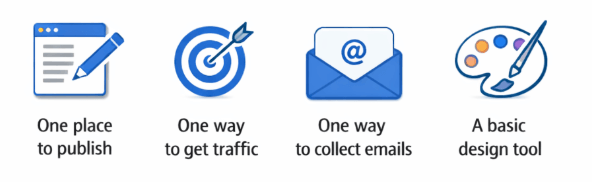
If you’re a beginner, you need:
One place to publish
One way to get traffic
One way to collect emails
A basic design tool
That’s it.
This post will walk you through the blogging tools beginners actually need... not the trendy ones, not the expensive ones, not the overwhelming ones.
Just the stack that works.
Build the system first. Add complexity later.
Why Most Beginners Overcomplicate Their Tool Stack
When you’re just getting started, everything feels urgent.
Every video says you need a different platform
Every blog post has a new “must-have” tool
Every creator has a link to something else you should buy
So you start stacking.
A website builder
An email tool
A funnel tool
A design tool
Another design tool “just in case”
Before you’ve written a single post, you’re managing subscriptions.
It’s not because you’re doing it wrong.
It’s because you’re trying to do it “right.”
You want to make sure you’re not missing anything.
You don’t want to fall behind.
You don’t want to waste time.
But here’s the truth:
More tools don’t make you more prepared.
They make you more distracted.
Beginners overcomplicate their tool stack because they confuse tools with progress.
Progress is publishing.
Progress is building traffic.
Progress is collecting emails.
Everything else is noise.
The goal isn’t to have the perfect setup.
The goal is to have a simple system you’ll actually use.
What Tools Do Bloggers Actually Use?
Most bloggers use the same basic types of tools.
Not dozens. Not complicated setups.
Just a few tools that support the work.
They use:
A platform to publish posts and collect emails
A traffic source to bring readers in
An email system to stay connected
A design tool for simple visuals
Basic keyword research to guide topics
That’s the foundation.
Advanced tools come later.
In the beginning, the goal is simple:
-> Write
-> Share
-> Capture
The Core Blogging Stack for Beginners
(Simple & Enough)
Now that you know the categories, here’s the simple stack that works for beginners.
This is enough to start.
This is enough to grow.
You don’t need more than this right now.
1. Blogging Platform
Your platform is your home base.
It’s where you:
Publish blog posts
Create simple landing pages
Collect email subscribers
Connect your offers
An all-in-one platform like Systeme.io keeps your blog, funnels, and email in one place.
One dashboard.
One system.
Less to manage.
No stitching together five different tools.
No bouncing between dashboards.
Simplicity matters because you’re still building momentum.
When your tools are scattered, your focus is scattered.
When everything lives in one place, you can focus on publishing and growing.
You don’t need endless customization.
You need a platform that lets you write, capture emails, and move forward without friction.
That’s enough.
2. Traffic Source
Publishing a blog is not the same as getting readers.
You need one steady way to bring people in.
Pinterest works well because it functions like a search engine. People go there looking for ideas, answers, and solutions.
Your content can show up when they search.
That means you’re not chasing attention.
You’re showing up when someone is already interested.
Pinterest also has a long lifespan.
A pin you share today can continue bringing traffic weeks or even months later. It doesn’t disappear in a day.
You don’t need to be everywhere.
You need one traffic source you understand and use consistently.
One source. One focus.
3. Email Marketing
Traffic is good.
But if someone reads your post and leaves, you may never see them again.
This is why understanding email marketing for beginners matters from day one.
With a simple built-in system inside Systeme.io, you can:
Capture subscribers
Send a welcome email automatically
Stay in touch over time
You don’t need complex sequences. You don’t need advanced rules.
You need a way to turn readers into subscribers.
That’s where growth starts.
Email lets you nurture. It lets you build trust.
It gives you more than one chance to serve the same person.
Without it, you’re starting from zero every day.
With it, you’re building something that compounds.
Keep it simple:
Capture
Send
Nurture
That’s enough at the beginning.
4. Graphic Tools
You don’t need to be a designer to grow a blog.
You just need your content to look clear and readable.
A simple tool like Canva is enough for most beginners.
You can use it to create:
Pinterest pins
Blog header images
Simple visuals for your posts
That’s it.
Your graphics don’t need to be perfect. They need to be clean.
-> They should help people understand what your post is about.
-> They should make someone want to click.
-> They should match your brand.
You don’t need advanced software.
You don’t need complicated layers.
You need a tool that helps you create consistent visuals without slowing you down.
Keep it simple.
5. Simple Keyword Research
Before you write, you need to know what people are already looking for.
Not guesses. Not random ideas.
Just clear signals.
A beginner-friendly tool like Keywords Everywhere can show you:
What people search for
How often they search
Related questions
You don’t need perfect data.
You need direction.
Keyword research isn’t about chasing the biggest numbers.
It’s about understanding intent.
What is someone trying to solve?
What question are they asking?
What outcome are they hoping for?
When you focus on intent, your content becomes useful.
And useful content builds traffic over time.
Keep it simple.
-> Find the question
-> Write the answer
-> Repeat
This stack covers content, traffic, and email.
Simple.
Focused.
Enough to move forward.
Which Blogging Platform Is Best for Beginners?
This question can feel overwhelming.
There are so many options. So many opinions.
But for beginners, the answer is simple:
Choose simplicity over customization.
You don’t need to change code.
You don’t need a long list of plugins.
You don’t need a perfect design.
You need a platform that lets you:
Write blog posts
Collect email subscribers
Create simple pages
Connect your offers
All in one place.
All-in-one is better than stacking tools when you’re just starting.
When you stack tools, you deal with logins, updates, and small tech issues before you’ve built any real momentum.
That slows you down.
Platforms like WordPress can be powerful.
But they often require hosting, themes, plugins, and setup work.
That’s a lot when you’re still learning how to publish consistently and get traffic.
You don’t need that yet.
A streamlined platform like Systeme.io keeps your blog, funnels, and email together.
One dashboard.
One system.
Less to manage.
If you want to see how it works, read the Systeme.io Review for Beginners and the guide on How to Create a Blog with Systeme.io.
Start simple.
You can add more later.
Right now, simple wins.
What Do You Really Need to Start Blogging?
Let’s make this simple.
To start blogging, you do not need a full studio.
You do not need fancy gear.
You do not need a big budget.
Here’s what you actually need:
A laptop
Internet access
A blogging platform
One traffic method
Consistency
That’s it.
-> You need a device to write
-> You need internet to publish
-> You need a platform to host your blog and collect emails
-> You need one way to bring people in
-> & You need to show up again and again
That last one matters most.
Now here’s what you do not need:
A camera
An expensive microphone
Paid ads
Premium themes
You don’t need to look impressive.
You need to be consistent.
Blogging is not about having everything set up perfectly.
It’s about starting with what you have and building from there.
Simple tools.
Clear system.
Steady action.
The 80/20 Rule of Blogging Tools
Here’s something that will save you time.
Most of your results will come from a small part of your effort.
About 20% of your tools will drive 80% of your progress.
That small 20% is simple:
Content
Traffic
Email
That’s it.
Your content brings value.
Your traffic brings people in.
Your email helps you stay connected.
Everything else is extra.
Tools by themselves do not create income.
A system does.
When your content connects to traffic,
and your traffic connects to email,
you build something that grows.
Focus on publishing.
Focus on bringing people in.
Focus on capturing leads.
You don’t need more tools.
You need to use the right ones consistently.
What You Don’t Need (Yet)
When you’re starting, it’s easy to think you need more.
More tools.
More features.
More dashboards.
You don’t.
Here’s what you can skip for now:
Multiple email platforms
Paid SEO suites
Advanced analytics tools
Team software
Ten different productivity apps
-> One email system is enough.
-> Basic keyword research is enough.
-> Simple traffic tracking is enough.
You don’t need complex data before you have real traffic.
You don’t need team tools if you’re working alone.
You don’t need five apps to manage your to-do list.
Too many tools slow you down.
More logins
More settings
More decisions
Keep it lean.
Use what supports your system.
Add more only when your growth demands it.
Simple now. Scale later.
Build the System, Not the Stack
Tools matter.
But the order matters more.
Your system is simple:
Pinterest → Blog → Email
Pinterest brings people in
Your blog builds trust
Email keeps the connection going
That’s the flow.
Download the ONE-SYSTEM STARTER MAP to see this flow laid out clearly before you build.
You don’t need five traffic sources.
You don’t need three email platforms.
You don’t need a long list of tools.
You need one focused workflow.
Create content
Share it
Capture emails
Repeat.
Start simple.
Get the system working first.
You can optimize later.
Right now, clarity beats complexity.
Build the system.
Then grow from there.
This Is Enough
If this still feels simple, that’s a good sign.
You don’t need a long list of tools to get started.
You don’t need to catch up to anyone.
You are not behind.
Most beginners slow themselves down by trying to build everything at once.
Simplicity is not a weakness.
It’s an advantage.
When your setup is clear, you move faster.
When your tools are focused, you stay consistent.
Start with the stack discussed.
One platform
One traffic source
One email system.
Create.
Share.
Capture.
Move forward with what you have.
You can grow from there.

Tye Davis
Clear Systems Hub exists to turn confusing online income advice into simple, repeatable systems you can actually follow. Clarity first. One step at a time.
I built this blog because I was the overwhelmed beginner... jumping between ideas, drowning in tabs, never quite launching. If that sounds familiar, you're in the right place
Clear Systems Hub is a practical guide to building online income through simple systems, tools, and repeatable processes.
Newsletter
Subscribe now to get daily updates.