How Does Pinterest Work for Beginners? (A Simple, Non-Social Breakdown)
Pinterest confuses beginners because it looks like social media, but doesn’t behave like it.
You’re told to post more. Be consistent. Show up daily. Chase trends.
And when none of that works, it starts to feel like you’re doing something wrong.
You’re not.
Pinterest wasn’t built for constant posting or personal visibility. It was built for discovery.
Quietly. Over time.
That’s why it works so well for people who want structure instead of noise.
& why it feels frustrating when you treat it like Instagram.
This guide is here to slow things down and shows you how Pinterest works so that Pinterest can finally make sense.
Not in a “do everything” way.
In a simple, system-first way.
One platform.
One purpose.
One way to use it without burning out.
What Pinterest Actually Is
Pinterest isn’t a social media platform.
It doesn’t care how often you post.
It doesn’t reward personality or engagement loops.
And it doesn’t require you to be “on” all the time.
Pinterest is a visual search engine.
People don’t open Pinterest to scroll. They open it to find.
Ideas. Answers. Inspiration. Solutions.
That means your content isn’t competing for attention in real time.
It’s being discovered when someone is actively looking for what you’ve created.
This is why Pinterest feels slow at first and powerful later.
A pin isn’t a post. It’s an entry point.
A board isn’t a feed. It’s a category.
& visibility isn’t borrowed from followers, it’s earned through search.
If you’ve felt exhausted trying to keep up elsewhere, this matters.
Pinterest works best when you stop trying to perform and start building content that can be found, saved, and revisited.
Quietly, over time.
How Pinterest Works Behind the Scenes
Pinterest runs on patterns, not popularity.
Every pin is scanned for context:
the image, the text, the link, the board it lives on.
That information tells Pinterest what the pin is about
and who it should be shown to.
When someone searches, Pinterest doesn’t ask who posted the pin.
It asks whether the pin matches the search.
That’s why follower count barely matters.
And why new accounts can still get traction.
Think of Pinterest like this:
You publish an asset.Pinterest tests it quietly.
If people save it, click it, or search for similar things...
Pinterest keeps showing it.
Think of Pinterest like this:
➡️ You publish an asset.Pinterest tests it quietly
➡️ If people save it, click it, or search for similar things...
➡️ Pinterest keeps showing it.
Not all at once. Over time.
This is also why results feel delayed.
Nothing is broken.
The system is learning.
Pinterest rewards clarity, not speed.
Consistency, not volume.
Alignment, not effort for effort’s sake.
Once you understand this, the pressure lifts.
You stop chasing visibility
and start building content that earns it.
How Beginners Should Use Pinterest (System-First)
Beginners struggle with Pinterest when they try to do everything.
Too many boards.
Too many pin styles.
Too many rules pulled from too many places.
That’s not how Pinterest works best.
Pinterest rewards focus.
A system-first approach is simple:
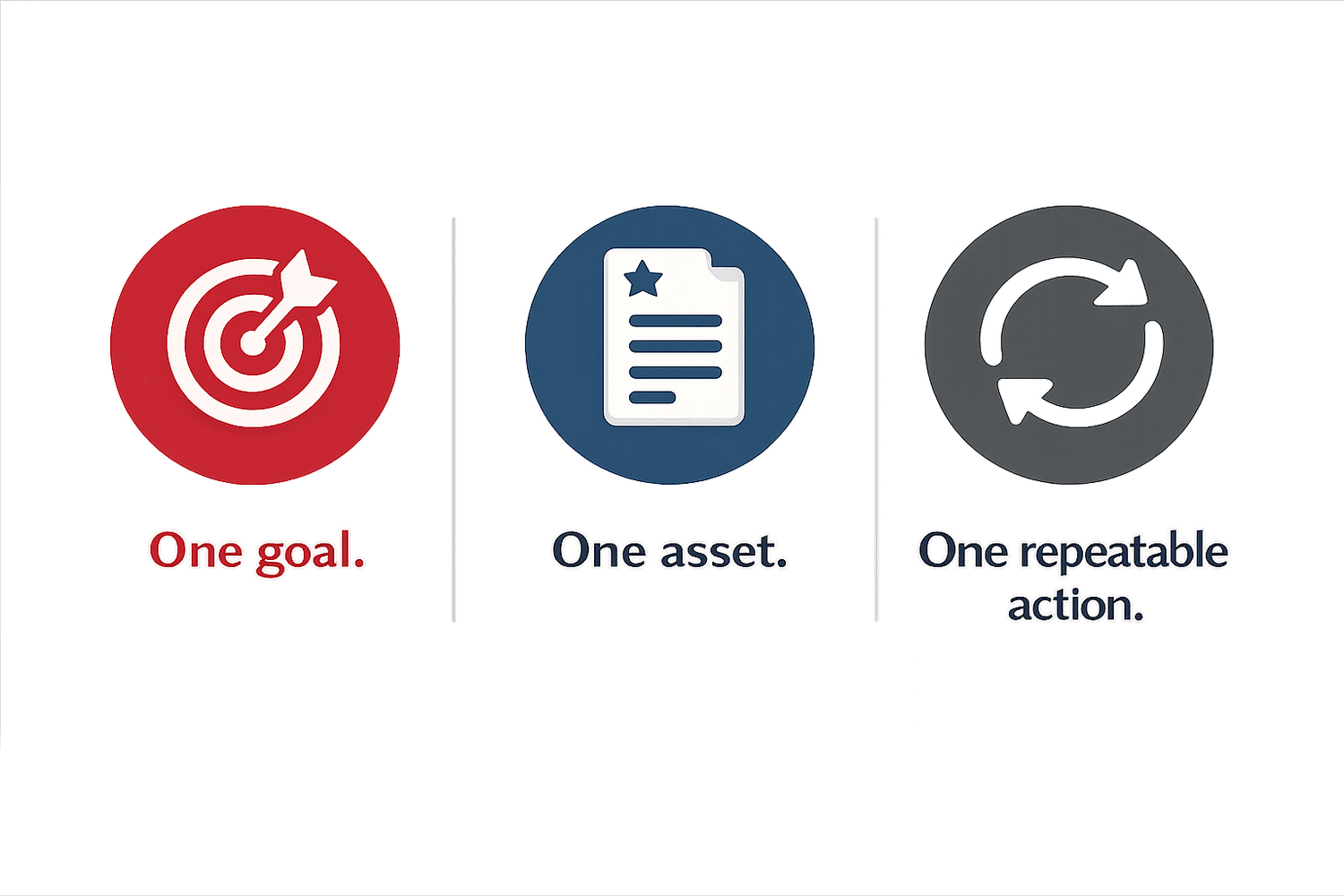
Your goal is traffic. Not followers, not virality, not daily engagement.
Your asset is content that lives somewhere else: a blog post, a page, a resource that doesn’t disappear.
Your action is creating pins that point back to that asset, using clear keywords and consistent structure.
That’s it.
You don’t need to post every day.
You don’t need to chase trends.
You don’t need to redesign your strategy every week.
You publish.
You pin.
You let time do its job.
Pinterest works when you treat it like a system you return to, not a platform you perform on.
Simple. Repeatable. Finished.
Common Beginner Mistakes (System Breakers)
Most Pinterest beginners don’t fail because Pinterest “doesn’t work.”
They struggle because the system keeps getting interrupted.
Here’s what usually breaks it:
Treating Pinterest like social media
Posting constantly. Watching likes. Obsessing over followers.
Pinterest doesn’t reward activity. It rewards relevance.
If you use it like Instagram, results will feel random and exhausting.
Trying to do too much at once
Too many boards. Too many topics. Too many strategies layered on top of each other.
Pinterest works best when it understands what you’re about.
Clarity beats coverage.
Skipping keywords
Pinterest is a search engine.
If you’re not using keywords in your pins, boards, and descriptions,
Pinterest has no context, and neither does the algorithm.
These are Pinterest mistakes by beginners:
Expecting instant traffic
Pinterest traffic builds over time.
Early weeks are about learning, testing, and indexing. Not results.
If you quit too soon, you interrupt the compounding effect.
Changing the system every week
New advice. New pin style. New “must-do” tactic.
Each reset sends mixed signals to Pinterest and keeps your content from gaining traction.
If you’ve made any of these mistakes, you’re not behind.
You’re just early.
Fixing them isn’t about doing more.
It’s about letting one simple Pinterest system run long enough to work.
How Pinterest Works in a Simple Online Income System
Pinterest isn’t the system.
It’s the distribution layer.
That distinction matters, especially for beginners.
Pinterest works best when it supports something else:
a blog post, a page, a resource you control.
On its own, Pinterest is discovery.
Paired with content, it becomes traffic.
This is why Pinterest works best when it’s used alongside a simple website & not as a standalone hustle.
Here’s the system:
➡️ You create one clear piece of content
➡️ Pinterest sends the right people to it
➡️ That content does the heavy lifting
No constant posting.
No audience management.
No pressure to be everywhere.
Pinterest doesn’t replace your system. It feeds it.
& because Pinterest traffic compounds, the work you do today keeps working quietly in the background.
This is what makes Pinterest different from most platforms.
You’re not starting over every week.
You’re building on top of what already exists.
For beginners learning how Pinterest works, this is the shift that changes everything:
Use Pinterest to support a simple online system... not to become the system itself.
The Real Takeaway
Pinterest isn’t complicated.
It’s just often explained that way.
For beginners, Pinterest works when expectations are realistic
and the system stays simple.
You don’t need to master everything at once.
You don’t need to be everywhere.
You don’t need to turn Pinterest into a full-time job.
You need one clear setup.
One piece of content worth sending traffic to.
& the patience to let Pinterest do what it’s designed to do.
When used the right way, quick wins on Pinterest isn't the route for beginners.
It’s about building something that keeps working after you step away.
One platform.
One purpose.
One simple online system.
If you want the whole system mapped out on one page, grab the ONE-SYSTEM STARTER MAP.

Tye Davis
Clear Systems Hub exists to turn confusing online income advice into simple, repeatable systems you can actually follow. Clarity first. One step at a time.
I built this blog because I was the overwhelmed beginner... jumping between ideas, drowning in tabs, never quite launching. If that sounds familiar, you're in the right place
Clear Systems Hub is a practical guide to building online income through simple systems, tools, and repeatable processes.
Newsletter
Subscribe now to get daily updates.